This article was published in the trade magazine Plastics Insight, issue 10/2026, www.plasticsinsights.com, © Carl Hanser Verlag
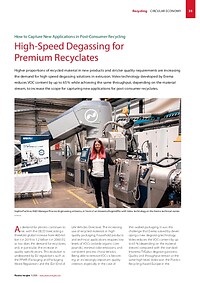
Higher proportions of recycled material in new products and stricter quality requirements are increasing the demand for high-speed degassing solutions in extrusion. VOLEX technology developed by EREMA reduces VOC content by up to 65 percent while achieving the same throughput, depending on the material stream, to increase the scope for capturing new applications for post-consumer recyclates.
As demand for plastics continues to rise, with the OECD forecasting a threefold global increase from 460 million tonnes in 2019 to 1.2 billion tonnes in 2060 [1], so too does the demand for recyclates, and, in particular, the increase in quality specifications. This evolution is underpinned by EU regulations such as the PPWR (packaging and packaging waste) and the ELV (end-of-life vehicle). The increasing use of recycled materials in high-quality packaging, household products and technical applications requires low levels of VOCs (volatile organic compounds), minimal odour emissions, and consistent process characteristics. Being able to remove VOCs is becoming an increasingly important quality criterion, especially in the case of thin-walled packaging. It was this challenge that EREMA solved by developing a new degassing technology. VOLEX reduces the VOC content by up to 65 percent (depending on the material stream) compared with the standard INTAREMA® TVEplus® degassing process. Quality and throughput remain at the same high level. VOLEX won the Plastics Recycling Award Europe in the Recycling Machinery Innovation category in May 2026.
Degassing redefined
The key relationships governing the degassing of plastic melts based on Fick’s first and second laws of diffusion and Henry’s law of solubility, as well as a multitude of physical parameters such as the diffusion coefficient, vapour pressure, boiling point, and viscosity, etc. [2–5], can be summarised as follows: The degassing speed increases with a larger surface area, shorter diffusion path, longer residence time, higher temperature and lower pressure.
VOLEX stands for Volatile Extraction and is an innovative degassing process that takes place during extrusion. It is based on a specially developed screw and cylinder geometry: a larger screw diameter in the degassing zone creates new capabilities for optimising surface renewal, residence time, and process efficiency. The decisive physical mechanism gives volatile components much more opportunity to escape from the melt. This special geometry ensures a surface renewal rate that is 320 percent higher than with EREMA's standard INTAREMA® TVEplus® degassing process.
If required, VOLEX technology can be combined with water stripping. In twin screw extruders, entraining agents have been used successfully for many years to improve degassing. VOLEX is the first process that enables water to be used as an entraining agent in a single screw recycling extruder without compromising on throughput or recyclate quality. In this process, water is fed at a precise rate into the filtered plastic melt in the patented Plus Zone of the INTAREMA® TVEplus® system. As the water evaporates, it creates minuscule inclusions in the melt so that the exposed surface area is increased a thousand-fold. This allows volatile substances to escape from the plastic matrix much more quickly and effectively and to be removed by the vacuum system. This gives plastic recycling companies the opportunity to customise their process precisely to match the required quality specifications.
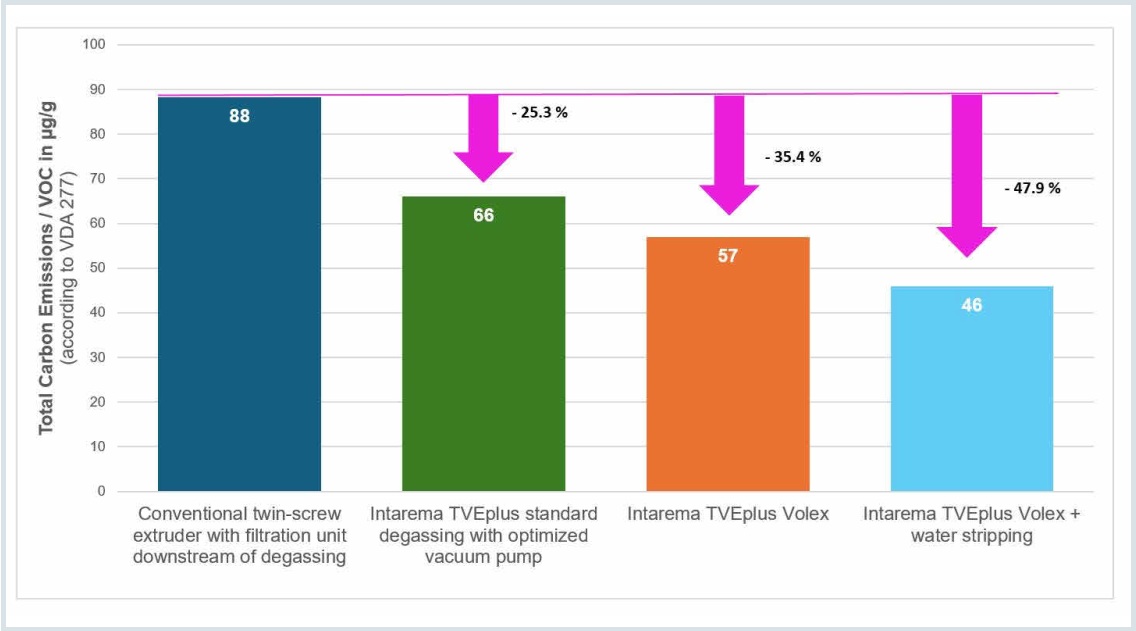
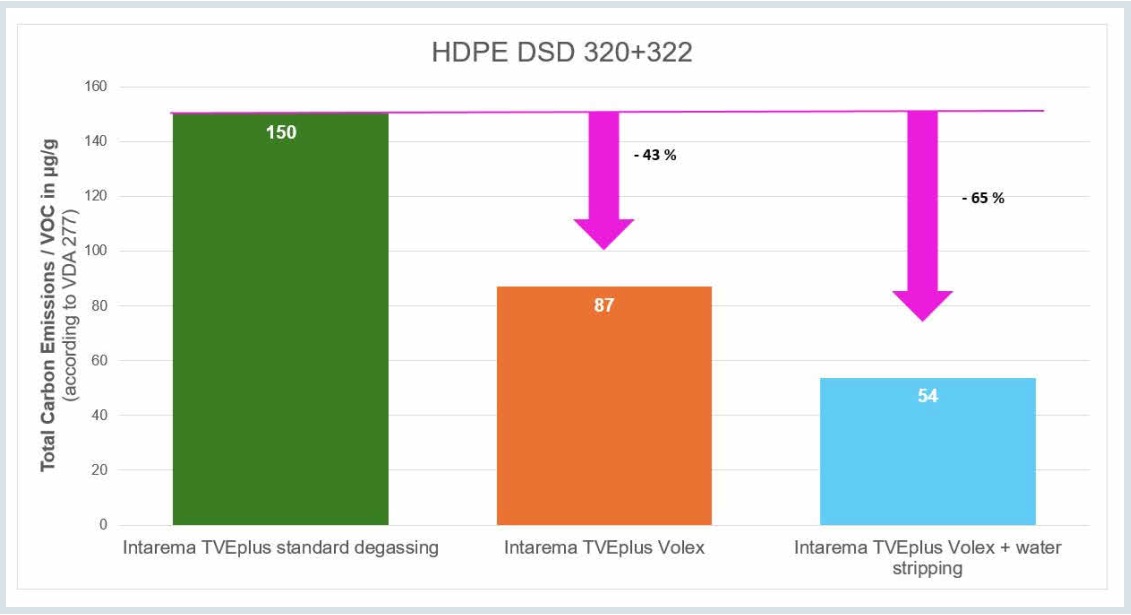
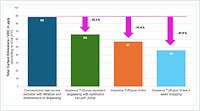
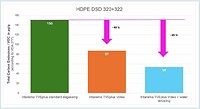
Trials using a variety of post-consumer and post-industrial material streams demonstrate the capabilities of VOLEX technology. Figure 1 shows that the technology reduces total carbon emissions in accordance with VDA 277 by over 35 percent compared with conventional twin screw extruders fitted with a filter at the extruder screw tip. Using water as the entraining agent reduces VOCs by almost half compared with the twin-screw system. In accordance with VDA 277, the VOC content was measured based on total carbon emissions. Figure 2 shows the reduction in VOC content in mixed HDPE flakes of poor sorting quality containing a high proportion of heavily printed film. Here, the VOC content was reduced by 43 percent, and by 65 percent with water stripping.
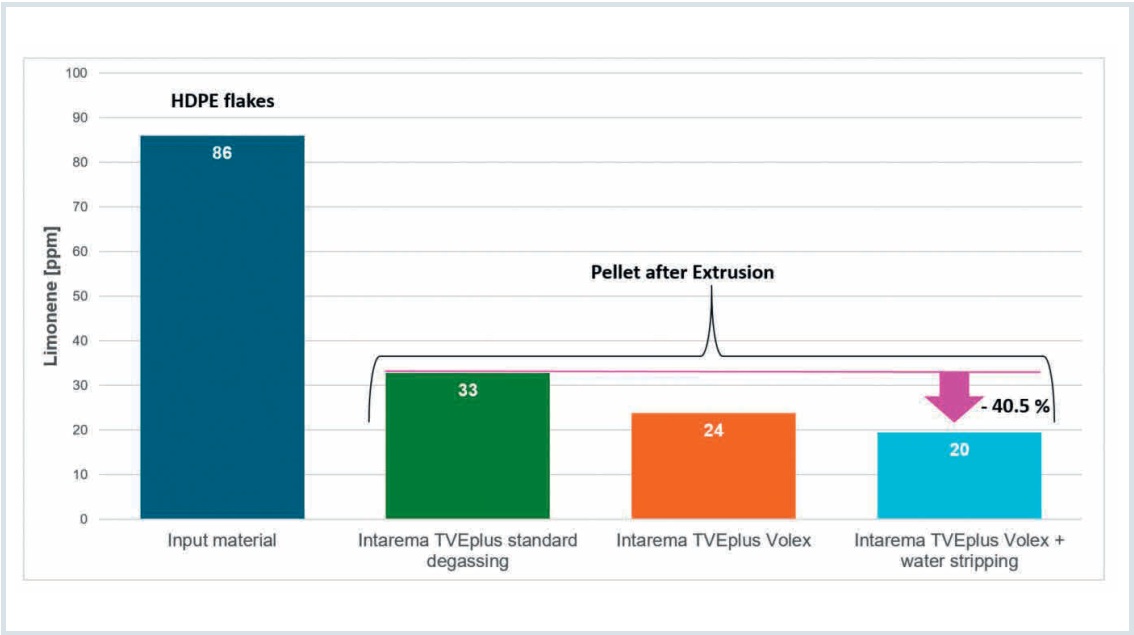
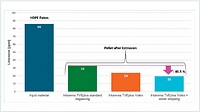
Moreover, EREMA performed trials using limonene as a tracer to assess degassing performance in various material streams, such as HDPE bottles from household waste collection. Limonene is used as an odour tracer in packaging for household and cleaning products. Figure 3 shows that VOLEX reduces the limonene content by more than 40 percent compared with the standard INTAREMA® TVEplus® degassing process. These results are particularly relevant because low levels of limonene are often a deciding factor in choosing recyclates for high-quality non-food applications.
Previously, post-treatment was often necessary for recycled pellets used in demanding applications. This resulted in additional investment, energy and running costs. Thanks to the high-speed degassing performance achieved by VOLEX technology, selected material streams have a level of quality that is high enough for them to be used in high-quality applications immediately after extrusion. These applications include packaging for household cleaning products, components for car interiors such as cable ducts, and other non-food and non-cosmetic-grade packaging and components.
The specifications for recyclates will continue to rise in the coming years, calling for solutions that achieve a high output at the same time as being cost-effective. VOLEX technology increases degassing capacity directly in the extruder, improves the quality of the recyclate and opens up new applications for recycled post-consumer plastics. This technology enables a significant reduction in VOCs and other compounds that cause odours to develop while achieving full throughput without requiring any additional process steps. This increases the scope for post-consumer recycling to capture new high-quality, premium applications, and significantly strengthen the circular economy.
Info
Text: Sophie Pachner, BSc, PhD, has been working in process engineering at EREMA since 2019, where she is head of the development and innovation team; s.pachner@erema.at
Service
More information on the manufacturer at www.erema.at
References
You can find the list of references at www.plasticsinsights.com/archive
PRESS CONTACT
Julia Krentl
Corporate Communication
EREMA Group
Unterfeldstraße 3
4052 Ansfelden, AUSTRIA
Phone: +43 732 3190 6092
Email: public.relations@erema-group.com